LMIA Process Explained: A Comprehensive Guide for Canadian Employers
In today's competitive landscape, Canadian businesses often need to look beyond our borders to find the specialized talent required to innovate and grow. However, hiring a foreign national isn't as simple as extending a job offer. The Canadian government has a system in place to ensure that hiring from abroad does not negatively impact its domestic labour market. At the heart of this system is the Labour Market Impact Assessment, or LMIA.
Navigating the LMIA process can seem daunting, filled with paperwork, specific recruitment requirements, and strict deadlines. This guide will break down the entire process step-by-step, providing you with the knowledge and confidence to successfully bring the international talent your business needs to Canada.
What is an LMIA?
The Labour Market Impact Assessment (LMIA) is a document that an employer in Canada may need to get before hiring a foreign worker. A positive LMIA will show that there is a need for a foreign worker to fill the job... and that no Canadian citizen or permanent resident is available to do the job.
In essence, an LMIA is an opinion from Employment and Social Development Canada (ESDC) that confirms hiring a foreign worker will have a neutral or positive impact on the Canadian labour market. A positive LMIA is sometimes referred to as a "confirmation letter."
Key Takeaway: An LMIA is for the employer, not the employee. It proves you've done your due diligence in trying to hire locally first.
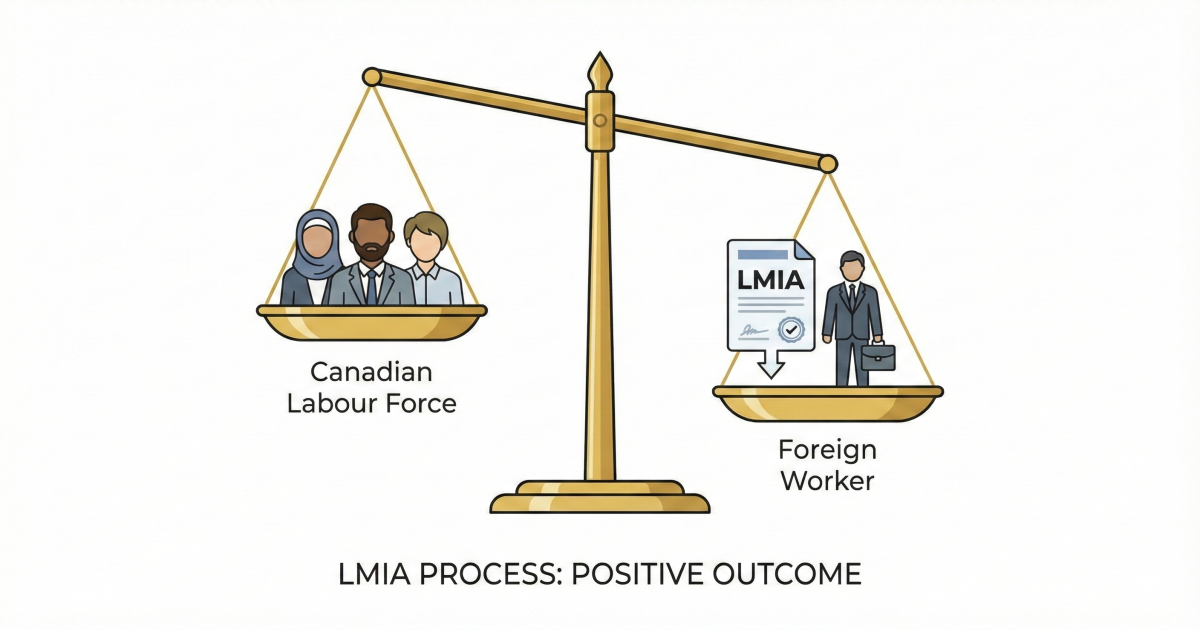
Image Suggestion: An infographic showing a balanced scale. On one side, there's an icon representing "Canadian Workers." On the other side, an icon for a "Foreign Worker." The LMIA document is shown as the weight tipping the scale towards the foreign worker, symbolizing the demonstrated need. This visually explains the core concept of the LMIA.
The Step-by-Step LMIA Process for Employers
The LMIA process is rigorous and requires careful attention to detail. Here’s how it works from start to finish.
Step 1: Determine if You Need an LMIA and Which Stream Applies
First, confirm that the position you're offering requires an LMIA. Some work permit exemptions exist, such as for intra-company transfers, certain professionals under free trade agreements (like the USMCA), or workers hired through the Global Talent Stream.
If an LMIA is required, you must determine if the position is high-wage or low-wage. This is determined by comparing the offered wage to the median wage for that occupation in the specific region where the job will be located. You can find the median wage on the Job Bank wage report.
- High-Wage Stream: For jobs at or above the provincial/territorial median wage.
- Low-Wage Stream: For jobs below the provincial/territorial median wage.
This distinction is crucial as it impacts your recruitment requirements and the length of time for which the work permit can be issued.
Step 2: Meet the Minimum Advertising and Recruitment Requirements
This is the most critical and heavily scrutinized part of the application. You must prove you have made genuine efforts to hire Canadians or permanent residents. The requirements vary slightly between high-wage and low-wage streams.
For the High-Wage Stream, you must:
- Advertise on the Government of Canada's Job Bank for a minimum of 28 days.
- Conduct at least two additional recruitment methods from a list of ESDC-approved options. These can include:
- Advertizing on a national or provincial job board (e.g., Indeed, LinkedIn, Monster).
- Placing ads in a national newspaper or professional journal.
- Posting on industry association websites.
- Using recruiters or headhunters.
- Holding job fairs or participating in campus recruitment.
For the Low-Wage Stream, you must:
- Advertise on the Government of Canada's Job Bank for a minimum of 28 days.
- Conduct at least one additional recruitment method from the same list of approved options.
All advertisements must include:
- The employer's business name and address.
- The job title, duties, and responsibilities.
- The salary and wage information (must meet or exceed the median wage).
- The location of the job.
- The skills and experience required.
- Contact information for the application process.
You must keep detailed records of all recruitment efforts, including copies of ads, the number of applicants, and why the Canadian applicants were not suitable.
Image Suggestion: A clean, organized screenshot mockup of a job posting on the Canada Job Bank website. Highlight key fields like "Wage," "Location," and "Date Posted" to show employers what to expect.
Step 3: Prepare and Submit Your LMIA Application
Once your recruitment period is complete, it's time to gather your documents. The main application form is the LMIA Application for Employers. You will also need to submit:
- A $1,000 non-refundable employer compliance fee for each position requested.
- A detailed job offer letter for the foreign worker.
- Proof of your business legitimacy (e.g., business license, articles of incorporation).
- Documentation of your recruitment efforts (copies of all ads, a summary of applicant screening, etc.).
- The foreign worker's CV and proof of qualifications (if applicable).
Applications are now submitted online through the IRCC secure portal. Be meticulous. Incomplete or inaccurate applications are a primary reason for refusal.
Step 4: Wait for a Decision and Potential Audit
After submission, ESDC officers will review your application. Processing times vary significantly depending on the stream and the volume of applications. You can check the latest processing times on the ESDC website.
During this period, the officer may:
- Approve the application as is.
- Request more information or clarification.
- Conduct an audit, which could involve contacting your references or the Canadians who applied for the job to verify your recruitment efforts.
Step 5: Receive the LMIA Decision
You will receive one of two outcomes:
- Positive LMIA: This is the confirmation letter you were hoping for. It will include an LMIA confirmation number that the foreign worker needs to apply for their work permit.
- Negative LMIA: This means ESDC was not convinced that hiring a foreign worker was necessary. The letter will explain the reasons for the refusal, which may include insufficient recruitment, a low wage offer, or errors in the application.
After You Get a Positive LMIA: The Next Steps
Your work isn't quite over.
- Provide the LMIA Confirmation Letter to the Foreign Worker: The worker needs this letter, which contains the unique confirmation number, to apply for their work permit.
- The Worker Applies for a Work Permit: The foreign worker must submit their work permit application to Immigration, Refugees and Citizenship Canada (IRCC), either from outside Canada or from within, depending on their situation. They can include their family members on their application.
- Maintain Employer Compliance: Once the worker is employed, you have ongoing responsibilities. You must:
- Provide the same wages and working conditions as stated in the job offer.
- Keep records of the employee's wages, hours, and duties.
- Cooperate with ESDC officers during inspections.
- Submit a compliance report if requested.
Failure to comply can result in penalties, including being banned from the LMIA program for several years.
Image Suggestion: A simple flowchart graphic. Box 1: "Positive LMIA Received" -> Arrow to Box 2: "Employer sends LMIA to Worker" -> Arrow splits to Box 3: "Worker applies for Work Permit" and Box 4: "Employer prepares for Onboarding & Compliance".
Final Thoughts
The LMIA process is undoubtedly a commitment of time and resources. However, it is a vital tool for businesses facing genuine labour shortages. By understanding the requirements, being meticulous with your documentation, and approaching the process with transparency, you can successfully navigate it and gain access to the global talent pool that will help your business thrive.
For complex cases, or if you're new to the process, consider consulting with an immigration lawyer or a regulated Canadian immigration consultant (RCIC). Their expertise can streamline the process and significantly increase your chances of a successful outcome.